
When you’re pitching for work to other freelancers, there’s no guarantee you’ll be chosen. These opportunities are highly competitive and require careful crafting and professional presentation, just like any other pitch.
Hop into any space where editors and proofreaders hang out, and at some point you’ll come across a freelancer inviting fellow editors to register their interest in a project. These posts might appear on editor forums or job boards, in social media posts, in online editor groups (e.g. on LinkedIn or Facebook) or in private groups (e.g. on Slack). Here’s a made-up (but typical) example:
I’ve had an enquiry from an author about copyediting a psychology journal article, but I don’t have the capacity. Ready Friday, with 10,000 words to be turned around within a week. Please contact me at [email] if interested and available.
It might seem like this kind of post would be a quick route to work. After all, the editor is on your side, right? They know how hard it can be to find work, so they’ll cut you a bit of slack? Especially if they’ve heard of you or you’re members of the same editorial organization, they should be keen to recommend you?
Not necessarily so.
It is just as important to sell your services to a fellow editor as it is to convince a client you’re the right fit for their project. Indeed, it’s arguably more important to do so, as the fellow editor’s insider knowledge may make them more discerning than a client about who will be a good fit.
(Note: from here on, please read ‘editor’ to include proofreaders too.)
How much work do editors get via other freelancers?
I was curious to find out whether editors get much work this way. I therefore started a poll on LinkedIn asking freelance editors to choose which of these categories applies to them:
- None of their work comes from job posts by fellow freelancers
- Up to a quarter of their work comes from this source
- Between a quarter and half of their work comes from this source
- Between half and all of their work comes from this source
Here are the results:
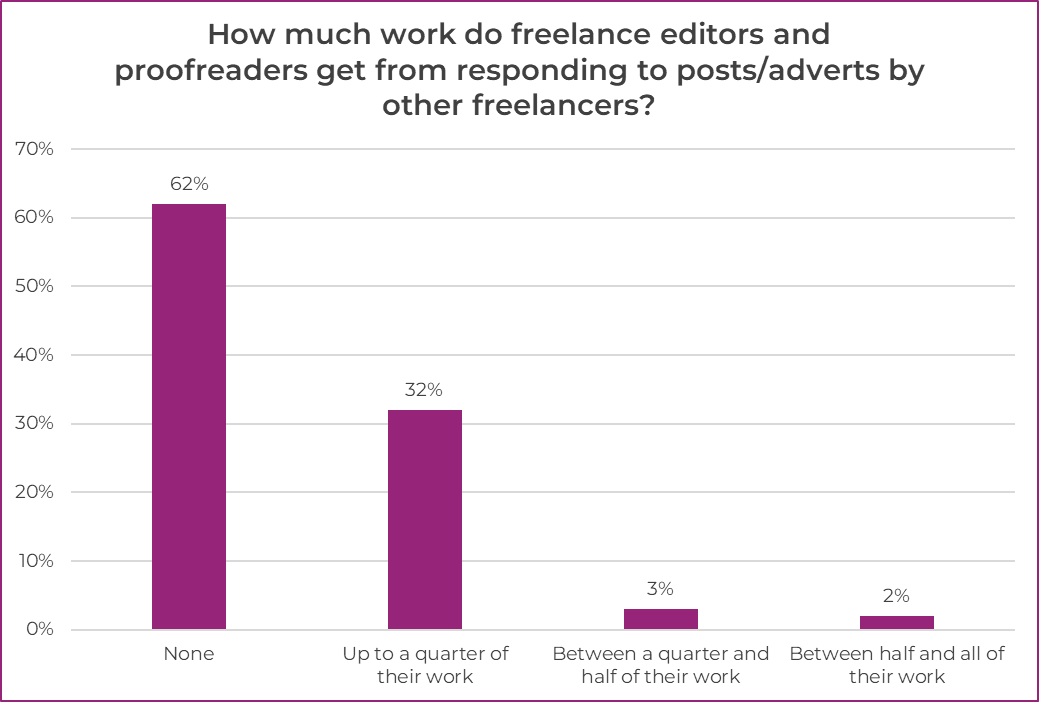
Among the 117 editors who responded to the poll, most (62%) get no work this way. This doesn’t seem surprising, for a number of reasons:
- These posts are relatively rare
- Especially if they are public, these posts may receive a lot of responses from interested editors (so the success rate is likely to be low)
- Because there is an intermediary between the client and the interested editors, it’s easier for the client to change their mind and quietly back out of the process without hiring anybody at all
However, a significant chunk of editors (32%) get up to a quarter of their work this way, rising to half for a further 3% of editors. Two respondents (2%) even get up to all of their work this way.
This data shows that there is clearly work to be had from job posts by fellow freelancers.
So, if this route appeals to you, it’s worth thinking carefully about your strategy and how you respond.
How to find job posts by fellow freelance editors
The first step in your strategy obviously needs to be to locate these posts.
Common sources include:
- Editorial society forums (some societies even have dedicated sections of their forums for this kind of post)
- Public social media posts on editors’ own profiles
- Social media posts within closed or specialist editor groups
- Private editor groups (often focused on a specialist topic) on services such as Slack or Discord
There is no secret corner of the internet where this kind of work hides, waiting to be discovered. Follow all the usual networking advice and join relevant editorial groups. Sooner or later, you should spot opportunities of this kind.
What do job posts by fellow freelancers look like?
These posts can take all kinds of forms, but here are three more examples I’ve made up:
POST 1
I’m currently doing a line edit of a client’s fantasy novel and they have asked for help finding a suitable proofreader. Currently 75,000 words but might end up around 70,000 after editing. The author is conscientious and great to work with. If you would like your name to be passed on to the author, please reply with (1) a brief statement of your interest and (2) a link to your website, CV or equivalent (e.g. a directory entry). I won’t have time to acknowledge messages, but I’ll pass them on to the author and they will get back to anyone they are interested in working with.
POST 2
I’m helping a couple of my clients find new editors as I’m retiring. The work consists of copyediting and proofreading reports, policy briefs and similar, mostly on the topic of demographics. The papers are data-heavy and often require quick turnarounds. The workload varies but averages around 20,000 words per month. If you’re interested, please contact me with details of your experience. I will collate a list of candidates for the client to consider.
POST 3
I’ve been contacted by a student who urgently needs their dissertation proofreading. Art history, 50,000 words. Ready now. Please contact the author directly at [email] if available.
Tips for getting work via other freelance editors
Let’s use these examples to consider some dos and don’ts of responding to job posts by other freelance editors. I’ve split these up into seven tips – use them as a checklist when you’re next responding to a post of this kind.
1. Follow the instructions
Just like when you’re applying for any role – freelancer or employed – the first hurdle is to show that you can follow instructions. If you trip over or crash heedlessly through this hurdle, you’re almost certainly not going to be shortlisted.
For example, Post 1 clearly asks for two things: a brief statement of interest and a link or document demonstrating your experience. So, don’t omit the statement… but don’t make it three pages long either. And make sure you include the link prominently – don’t expect the freelancer to dig it out of your email signature.
2. Follow the hidden instructions
This tip could equally be called ‘follow good business practice’ or ‘use your common sense’. For example, Post 2 doesn’t say anything about how to supply your contact details, but it makes sense not to hide them at the end of a long email attachment. Post 2 also doesn’t specify any format for the ‘details of your experience’, but it makes sense to provide this information in a standard format (such as a brief covering statement and a link to your portfolio).
If the fellow freelancer is seeking to offload work, it probably means they are busy. Make their lives easier by packaging your reply in as user-friendly a way as possible. It’s not their job to make you discoverable or unearth why you’re a good fit for the project.
Also on the topic of contact details: don’t go digging online for the poster’s personal email or phone number. Yes, it happens, and it’s creepy. Respect the boundary between their personal and professional lives, and contact them via a standard professional route (such as the email address on their website or a professional social media profile).
3. Don’t waste anybody’s time
This one runs through every tip in this list, but I’m giving it its own number because it’s so important: don’t put yourself forward for opportunities you’re not qualified for.
I get that work can be hard to come by and that it makes sense to try for everything you realistically can. But ‘realistically’ is the key word here. You won’t do yourself any favours if you force the fellow freelancer to spend time looking through your obviously unsuitable pitch. You never know when the same freelancer might have opportunities again in the future – don’t get yourself blacklisted by responding indiscriminately.
(That said, I’ve also written about how you don’t need to be overqualified for a position, just qualified. Know your worth and don’t limit your horizons unnecessarily.)
4. Pay attention to the relationships
Make sure you understand who you should contact and what will happen next (if this isn’t clear in the freelancer’s post, ask).
For example, Posts 1 and 2 both clearly say that the freelancer will pass suitable people’s details on to the client. So don’t respond to the freelancer asking how you should contact the client.
In contrast, Post 3 states that you should contact the client directly. It’s usually best to do this without trying to contact the freelancer for more information first. They are likely to be busy (given that they haven’t taken on the work themselves) and may not know anything further anyway.
If you contact the freelancer directly, also think carefully before chasing them for a reply. Depending on where the post appeared, they may have got dozens of replies. Plus, by their very nature, these are often hurried interactions where the freelancer is simply trying to link up two suitable people and then move on. Especially in the case of Post 3, the freelancer is unlikely to be keeping tabs on the outcome.
5. Embrace the freelance mindset
It’s fundamental to understand your place in the relationships at play. Sometimes the contractual situation is fairly straightforward – if, for example, the freelancer’s post specifies a fee and turnaround time, or even proposes a subcontracting relationship, you should usually only respond if you’re happy with those arrangements.
But in other cases the relationships can be delicate. For example, if you’re replying to Post 2, what if the client is surprised to find that your rates are much higher or lower than the other editor’s? And what if your terms and conditions require a totally different way of working from what the client is used to?
Clearly, you should be respectful of the fellow freelancer and not do anything to undermine their relationship with the client. But, at the same time, you’re negotiating a new contract that will ultimately be nothing to do with the previous editor. The onus is on you, as an independent freelancer, to present your unique offering for the client to consider.
And whatever you do, don’t slip into an employee mentality. There’s a crucial difference between pitching for freelance work and applying for an employed role. Freelance managing editor Melanie Padgett Powers recently posted on LinkedIn about a deluge of unsuitable enquiries she received from writers who seemingly had failed to internalize this important distinction, and her insights are well worth a read.
6. Acknowledge the freelancer’s generosity
The freelancer is being generous to the client by giving their time to help them find a suitable editor (after all, they could simply have said ‘nope, not available’). But they are also being generous to their fellow freelancers and contributing to the good standing of the editorial profession as a whole.
A client who can’t find a suitable editor quickly might give up and do the work themselves (potentially with generative AI). But the freelancer is trying to avoid that by getting relevant names in front of the client.
Similarly, the more work that is placed, the more client–editor relationships are being forged and the more editors are earning, and so the healthier our profession and the more likely we all are to be able to give back in some way.
If appropriate, therefore, briefly thank the freelancer when you reply. They might not have time to acknowledge your thanks, but you’ll have done your little bit to prop up the cycle of edibuddies supporting each other.
7. Show enthusiasm!
If this was one of those clickbait articles that talked about ‘the one secret ingredient’, this would be it.
My dog is waiting patiently to go out for her walk as I type this, so I’ll use her as metaphor fodder: you don’t need to adopt excited puppy levels of enthusiasm, but a good, solid tail wag shows you’re eager to take on the work and respectful of the opportunity.
I’m going to be blunt here: if you can’t muster this level of enthusiasm, I’d suggest thinking carefully about whether you’re the right editor for the job at all.
A cold or detached response at best may lose you an opportunity to stand out, and at worst risks coming across as entitled.
Summary: help them to help you
As my data shows, other freelancers’ job posts can be a good source of editorial work.
When you’re responding to these posts, make it as easy as possible for the fellow freelancer to pass your details along to the potential client. Don’t make them read between the lines, and don’t make them do the work to decide whether you’re a good fit for the project.


0 Comments